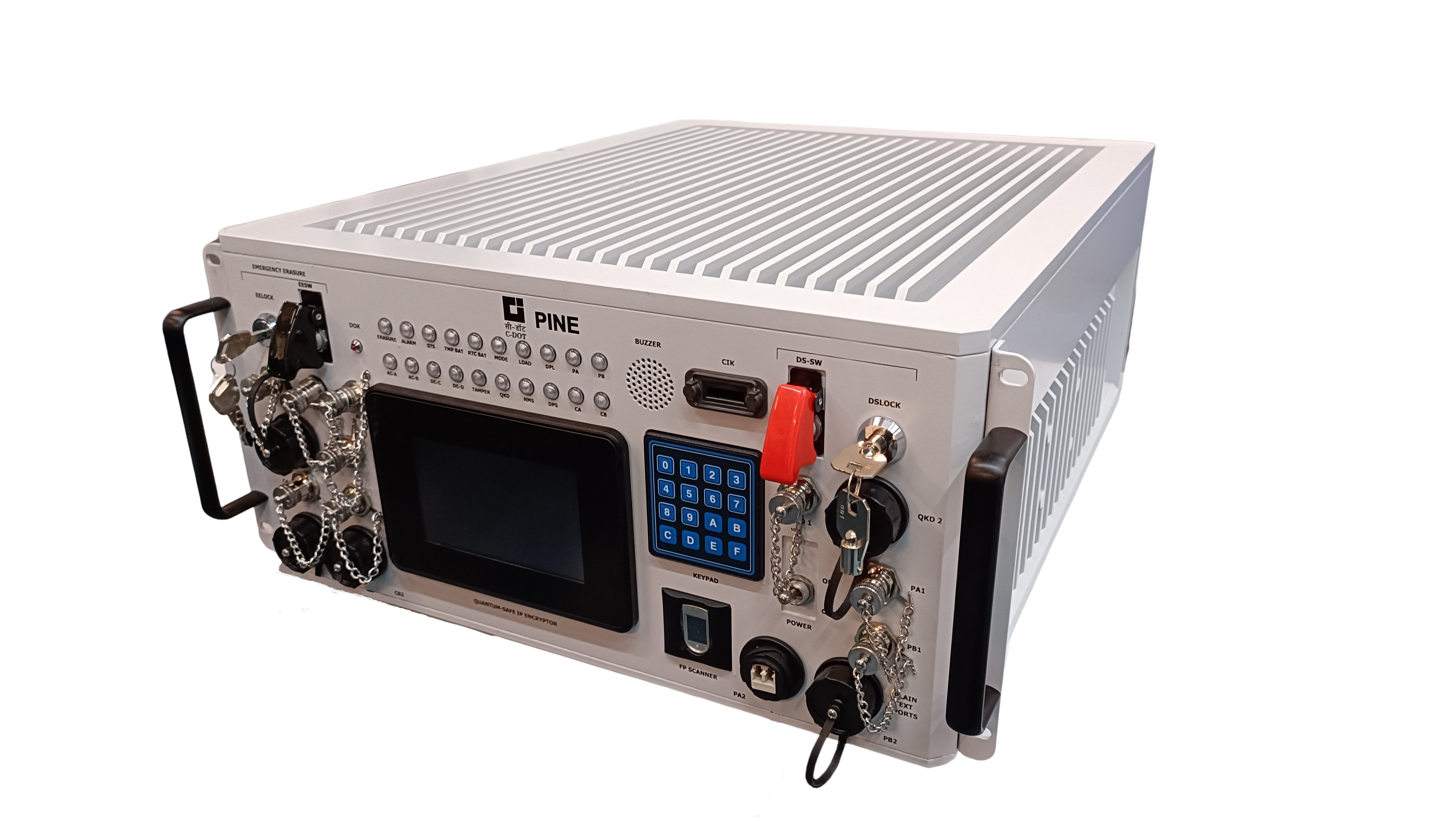
PINE is a state-of-the-art FPGA based IP network encryption equipment supporting post-quantum NIST FIPS-203 ML-KEM standard compliant key generation mechanism along with quantum-safe symmetric encryption (AES 256 GCM) of Ethernet frame (L2) and IP packet (L3) payload data at 1 Gbps encryption throughput rate.
Enhanced IPSEC framework supports establishment of multiple security associations between two or more peer PINE encryptors in a point-to-multipoint network topology.
View Product Video
Crypto Features
• Hybrid NIST FIPS-203 ML-KEM and Static Keys based encryption key generation
• AES-256 GCM Symmetric Encryption
• Side Channel Leakage resistant crypto IP Cores
• In-built NIST SP 800-90B compliant TRNG
• Red-Black Encryption Separation
Networking Features
• Enhanced IPSEC ESP tunnel encapsulation
• Point-to-Multipoint Network Topology Support
• 1 Gbps encryption throughput
• Ethernet frame (L2) and IP Packet (L3) Payload Encryption
• In-band post-quantum FIPS-203 ML-KEM key generation
Security Features
• Rugged conduction cooled enclosure
• Active tamper monitoring with battery backup
• Field replaceable Lithium battery
• Circular pin connectors with custom cables for security
• Emergency Erasure Switch
• Multi-factor authentication based user identification
System Features
• FPGA based design for high throughput and low latency
• Touch screen based on-board system GUI
• SNMPv3 based NMS Support
• Tabletop & 19” telecom rack compatible equipment
• Hot-standby power supplies (AC & DC), 200 W (Typical)
• 5U (EIA), 8.75” H X 19” W X 23” D, Weight < 25 Kg
Interfaces
• Plain Text Ports: Two 10/100/1000 Base-T interfaces and Two 1G/10G Single Mode Duplex LC Connector
• Cipher Text Ports: Two 10/100/1000 Base-T interfaces and Two 1G/10G Single Mode Duplex LC Connector
• One USB 2.0 (Device Mode) port for Fill Gun
• One USB 2.0 (OTG) port for Algorithm Loading Device (ALD)
• One USB 3.0 port for Software loading (SLP)
• One RS232 serial interface
• One USB-UART Console Interface
• QKD interface (1 G Ethernet MACsec – Copper & Optical-OM3)
• NMS interface (1 G Ethernet MACsec – Copper & Optical-OM3)
• GUI Interface (1 G Copper)
Dimension
• 5U (EIA) 8.75” H X 19” W X 23” D
Power Supply
• DC Ports : 18-75 VDC (Two)
• AC Ports : 90-275 VAC (Two) 50-60 Hz
• All power supplies are in hot standby mode (220V AC to 24V DC adaptor shall be provided for DC ports) Cooling/Thermal
• Conduction cooled fan less system
Battery
• Two external battery ports for RTC and Tamper
• Li-SOCl2 Type D 3.6 V Primary Cell (Two)
Power Consumption
• Power consumption 200 Watts (Typical)
LED Indications
• For encryption
• For power
• System Alarm
• Emergency Erasure
• Tamper
User Interface
• CLI /On-board Touch GUI/Web GUI
Emergency Erasure
• Keylock switch based emergency erasure (Two keys)
System Destruction
• Keylock switch based system destruction (Two keys)
Security Token
• Crypto Ignition Key (CIK) token
Crypto Features
• Hybrid NIST FIPS-203 ML-KEM and Static Keys based encryption key generation
• AES-256 GCM Symmetric Encryption
• Side Channel Leakage resistant crypto IP Cores
• In-built NIST SP 800-90B compliant TRNG
• Red-Black Encryption Separation
Networking Features
• Enhanced IPSEC ESP tunnel encapsulation
• Point-to-Multipoint Network Topology Support
• 1 Gbps encryption throughput
• Ethernet frame (L2) and IP Packet (L3) Payload Encryption
• In-band post-quantum FIPS-203 ML-KEM key generation
Security Features
• Rugged conduction cooled enclosure
• Active tamper monitoring with battery backup
• Field replaceable Lithium battery
• Circular pin connectors with custom cables for security
• Emergency Erasure Switch
• Multi-factor authentication based user identification
System Features
• FPGA based design for high throughput and low latency
• Touch screen based on-board system GUI
• SNMPv3 based NMS Support
• Tabletop & 19” telecom rack compatible equipment
• Hot-standby power supplies (AC & DC), 200 W (Typical)
• 5U (EIA), 8.75” H X 19” W X 23” D, Weight < 25 Kg
Interfaces
• Plain Text Ports: Two 10/100/1000 Base-T interfaces and Two 1G/10G Single Mode Duplex LC Connector
• Cipher Text Ports: Two 10/100/1000 Base-T interfaces and Two 1G/10G Single Mode Duplex LC Connector
• One USB 2.0 (Device Mode) port for Fill Gun
• One USB 2.0 (OTG) port for Algorithm Loading Device (ALD)
• One USB 3.0 port for Software loading (SLP)
• One RS232 serial interface
• One USB-UART Console Interface
• QKD interface (1 G Ethernet MACsec – Copper & Optical-OM3)
• NMS interface (1 G Ethernet MACsec – Copper & Optical-OM3)
• GUI Interface (1 G Copper)
Dimension
• 5U (EIA) 8.75” H X 19” W X 23” D
Power Supply
• DC Ports : 18-75 VDC (Two)
• AC Ports : 90-275 VAC (Two) 50-60 Hz
• All power supplies are in hot standby mode (220V AC to 24V DC adaptor shall be provided for DC ports) Cooling/Thermal
• Conduction cooled fan less system
Battery
• Two external battery ports for RTC and Tamper
• Li-SOCl2 Type D 3.6 V Primary Cell (Two)
Power Consumption
• Power consumption 200 Watts (Typical)
LED Indications
• For encryption
• For power
• System Alarm
• Emergency Erasure
• Tamper
User Interface
• CLI /On-board Touch GUI/Web GUI
Emergency Erasure
• Keylock switch based emergency erasure (Two keys)
System Destruction
• Keylock switch based system destruction (Two keys)
Security Token
• Crypto Ignition Key (CIK) token